

Text: STORYTELLER/MH
Photo: Archive - designed by Storyteller
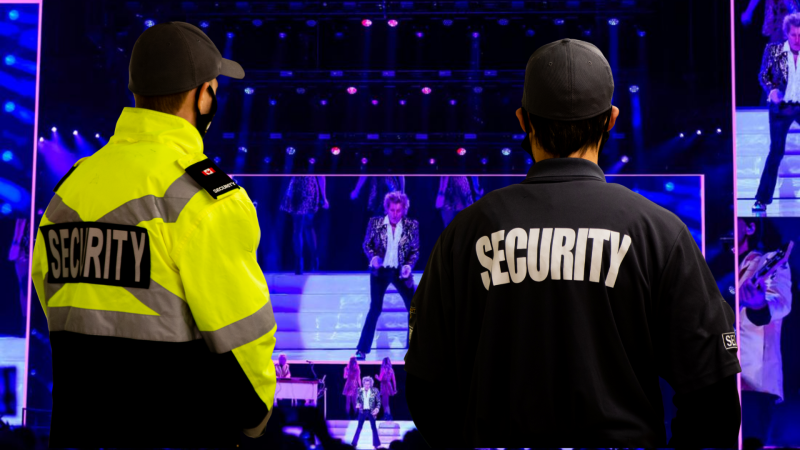
Security is a top priority these days, and rightly so, because all too often incidents or attacks occur at events or large gatherings. This category also includes concerts by international music stars such as Bruce Springsteen, Paul McCartney and Rod Stewart.
To protect visitors to these events, organisers also hire external security personnel to ensure that everything runs smoothly and that the audience is safe. This is not always successful, as recently demonstrated by the attack on a Jewish festival in Sydney, which left 16 people dead and 40 injured, and the attack on Ariana Grande's concert in Manchester in 2017, when a suicide bomber killed himself and 22 concertgoers and injured 116 others.
Fortunately, 99 per cent of events run smoothly and without major incidents, thanks in part to the security personnel on duty. But what if security staff take themselves too seriously and become harsh and aggressive towards the audience for no reason?
This is exactly what happened at Sir Rod's performance in Athens on Saturday, but the singer on stage refused to put up with it and intervened.
At first, the evening proceeded as usual. Rod sang his songs, the fans in front of the stage and in the stands were having fun and enjoying a great evening, wanting to be as close to their idol as possible. At the front, directly in front of the stage, fans jostled to get the best view of Stewart, and also to take the perfect souvenir photo or maybe even high-five their idol. Completely normal occurrences in concert halls and arenas around the world.
In Athens, however, some security guards took their job a little too seriously and repeatedly instructed visitors in the front rows in a very rude and harsh tone to stay in their assigned seats.
Stewart did not miss this, and when the obligatory footballs were thrown at the start of ‘Da Ya Think I'm Sexy’ and Rod wanted to throw a ball to a female fan, who was pushed away by an overzealous security guard, Rod finally lost his temper.
With a quick gesture, he instructed his band to stop playing and angrily confronted one of the security guards who had apparently intervened too rudely. ‘Get the hell out of the way,’ he snapped at the man. "You're ruining the show for everyone. Get out of the way. We don't need you here, all she's doing is holding up a sign. That doesn't hurt you, does it, mate?" Rod then threw the ball into the crowd and continued the song.
Unfortunately, such incidents are not isolated cases. Time and again, during Rod Stewart concerts (and certainly not only at those), security personnel take themselves far too seriously and overstep the boundaries of their job. The author of these lines remembers another case from England, when a Stewart fan was ‘arrested’ by security personnel and led away like a serious criminal, just because a roadie wanted to hand her a set list of the concert that had just ended from the stage.
We all agree that security personnel are definitely necessary at large events. But everything must remain within reasonable limits, of course. Nobody needs people who act all high and mighty just because they wear a security agency uniform. We wanted to find out how aware security companies are of this issue and to what extent they can ensure that their employees don't overstep the mark when on duty. To this end, we spoke to Mick Gastorf, a former owner of a security company in Stuttgart. Mick, who got his name because his father is a big Rolling Stones fan, now lives in Portugal and also spends several months each year with his family in Thailand. We reached him there by phone this morning.

Mick Gastorf
Storyteller: Are you aware of the problem that security guards often perform their duties in a rude manner, approaching or accosting visitors beyond the limits of what is permissible and being unfriendly or unhelpful?
Mick Gastorf: Yes, this is well known in the scene, but it's hard to stop. The organiser has the right to enforce house rules and is responsible for the hall or arena. This means they are responsible for everything that happens at the event. They must brief the security company thoroughly and describe in detail how employees should behave in specific situations. This also includes pointing out that an artist likes to bring his fans onto the stage or, as in the case of Rod Stewart, that the artist interacts with his audience. This tells the security personnel how to behave in certain situations. But there are always employees, I like to call them the ‘super security’, who in such situations think they are God knows who and act like big shots. Unfortunately, you can't rule that out 100 per cent. So you can't rule out the possibility that something like that might happen.
ST: In this context, what do you think of Rod Stewart's behaviour on Saturday in Athens? Can the artist's intervention actually make a difference so that such incidents don't become the norm?
MG: It's difficult to say. Rod probably snapped at the wrong person. The organiser is always responsible for providing the security company with the relevant information. Individual employees can only act as they have been instructed to do.
ST: How can something like this be prevented?
MG: With specific instructions. We used to brief our employees accordingly and didn't have to deal with such cases very often. I would have immediately removed an employee who was approached in the same way as our colleague in Athens and assigned them to another position in the arena.
ST: Keyword: briefing. How did you prepare your employees for events back then?
MG: We always prepared all employees for the event down to the smallest detail; that is also part of the duties of a security company. The briefing is usually also provided in writing and employees must confirm this with their signature. At least that's how it is in Germany; I don't know how other countries handle it. At the time, for example, we always communicated that someone might be brought on stage or that the artist might otherwise involve the audience in their show.
ST: What can visitors do, how should they behave if a security guard treats them rudely?
MG: Clearly, file a complaint. Every security guard must wear a card with their name on it or be able to identify themselves by name in some other way. And then you can file a specific complaint about them with the organiser. They will then contact the relevant security company.
We would be interested to hear your opinion on this topic. Have you ever been the victim of a security guard who went too far? How do you view the role of security personnel in general? And what is your overall opinion on this topic? Feel free to join the discussion and share your opinion with us in the comments section below.
Kommentar hinzufügen
Kommentare